



The events that developed in the world after the speech of Russian President Vladimir Putin at the Munich Conference in 2007, up to the conflict in the Middle East, quite logically led to an unprecedented process of transformation of the geopolitical space.
Today, this transformation has not yet had any formal consequences on the political map of the world, however, the processes that were launched in August 2008 in Georgia show no signs of stopping, and as a result, continue the final destruction of the old world order.
In fact, we are seeing a process of collision between two geopolitical systems. Where one system is, let's call it today, dissatisfied with their geopolitical weight countries, with signs of an authoritarian system, another is a system of democracies that built its position as a result of the disappearance of the Soviet Union, and a privileged position in the economic and security space.
This clash has many reasons, but if we consider all this from a military point of view, we will rightly see that the main reason was the uncompromising belief of this very democratic system in the permanence of peace without the need to use deterrent force and the absolutely logical use of this mistake by the other side, which ultimately took advantage of this and resorted to the forceful advancement of its own interests.
By the way, this situation later caught up with another country that decided to use force in the Middle East, which instead of the expected support received the same “concern” that is so familiar to Ukraine.
Continue after commercialADVERTISING
This clash manifests itself in the disruption of the so-called global balance, where the rules, however unfair they may be for some countries, that regulated security, global trade, investment, and other areas on a global scale, no longer work. Or they still work, but are being profoundly transformed before our eyes.
Today, it is already possible to say with confidence that Russia, China, the USA, and Iran are practically involved in the destruction of this geopolitical formation.
Of course, absolutely certain, each of these countries challenges the existing order in its own way, having only its own capabilities and interests.
For example, China is still building its own influence: from Africa to the Far and Middle East, using its economic capabilities, infrastructure and technological presence. China does not resort to military force, but like the United States in the era of industrialization of the early 20th century, is relentlessly developing military power, supporting Russia's war with Ukraine.
The United States, trying to prevent such actions by China, is abandoning its own geopolitical position in the old world, first through customs and trade wars and eventually using force in Venezuela and the Middle East.
Russia, limited by economic capabilities and lack of technology, following its own historical logic and using demographic opportunities, is once again resorting to territorial restoration of the empire.
However, for Russia, empire is not enough; it needs influence due to the fear of its neighbors, so in parallel with the war for empire, Europe receives from Russia migration pressure, disinformation, energy blackmail, and signs of division in Europe itself.
There is no point in discussing the events in the Middle East today. These events have only confirmed the destruction of international law and the final rejection of diplomacy as a tool for resolving international disputes. And therefore, the process of destroying the world order continues and already demonstrates the absence of the basic concept of international security. The Gulf War confirmed that having borders no longer means sovereignty. Sovereignty is a force that protects. The most important question is, what kind of force is this? And what can be done so that the next one is not you and your state?
First, a purely technical question
First of all, the rapid development of technology is what affects and will affect the nature of international security. I've been explaining what it is here in Britain for almost two years without stopping. However, it was the fighting in the Middle East that confirmed another axiom that the very “concerned” former power did not want to see in Ukraine.
This axiom is that in a war of attrition, relatively cheap, accessible to any country or organization, and, if desired, scalable drone systems can cause very large losses to the economy, especially through strikes on energy infrastructure. It should be noted that protection against such systems, as on the battlefield, does not exist today. And if it exists, it leads to the following conclusion: it is the most accessible tool to make the war economy expensive and impossible for the further continuation of such actions. After all, today's air defense is not able to guarantee protection against, for example, combined attacks.
The same experience in the Middle East shows that while the US, following an outdated doctrine, strikes military targets with expensive high-precision weapons, Iran skillfully uses combined attacks on infrastructure. It is this infrastructure that is absolutely impossible to protect today. Therefore, in order to control, for example, the flow of energy resources, today it is no longer necessary to have Krupp factories (German heavy industry company Friedrich Krupp AG), expensive air and missile forces, or a large fleet. Does that scare you today? Probably not.
Then I will return once again to access to these technologies and the ability to destroy or terrorize, for example, the energy sector.
Don't you think that very soon there will be not only states, but also, for example, international terrorists who will want to take advantage of these opportunities.The time of global changes and the lack of understanding of this by former major actors is the most favorable for this.
What is necessary to be done?
It is necessary to accept a difficult truth. Not being in the epicenter of hostilities no longer means being safe. Having borders and an own economy is just a goal, not a defense. Sooner or later, someone will demand tribute.
An immediate review of the security architecture, without concerns and upgrading something in an already broken mechanism, is the only guarantee of security.
The concepts of a security system and the marketing and development of weapons or technologies are not the same and cannot replace each other. The security system is policy, doctrines, and implementation strategies. Weapons systems and technologies are tools that change the way to achieve goals on the battlefield. Their development should serve to strengthen the security system, not the other way around.
So, from a technical point of view, I hope everything is clear. However, that's not all.
The presence of even new weapons does not automatically guarantee the presence of the same force that secures independence.
The point is that if we are talking about a force that is capable of protecting or preventing, then this force must be capable of fighting. But it is not only weapons that fight, but also people, and ultimately the totality of combat capabilities also includes the systems of management and logistics, and the preparation and readiness of the entire state for war. This means the willingness of politicians to make unpopular decisions, and the willingness of society to support them.
This is where the main problems start, which began in 2008.
That is why the deficit of political will on the one hand and dependence on electoral sentiment on the other have turned military advantage into a decisive and lasting “concern” and, as a result, led to the destruction of world order and the threat of world war.
By the way, the same problem can ultimately affect the course of the war, where constant appeal to public sentiment inevitably leads to mistakes that can be fatal.
But all of that has already happened. We are talking about the future and what you should do now.
To answer this question, it is necessary to return to the destruction of the world order as a fact of the collision of two systems. Because, thank God and Ukraine, democracies are not fighting among themselves yet, but democracies will still have to fight for themselves. If not with people, then with technology.
But it is precisely in a democracy that the military force we are talking about, and which I hope is nevertheless being transformed, is not separate. It functions entirely dependent on political legitimacy, the electoral cycle, budgetary compromise, and public consensus.
Of course, no one is underestimating the importance of the assistance that Europe and Britain provide to Ukraine. However, the issue of security is more global. Therefore, any “determination” without internal consensus and effective solutions is nothing more than the same “concern”.
So, given all this, governments need to put aside the ratings and resort to explaining why such unpopular steps are necessary. This applies to all countries that consider themselves democracies without exception.
It is perhaps the most difficult issue for Europe and the United Kingdom. Because if we are talking about social consensus and society and we mean social cohesion formed on the basis of explanation, then let's say honestly that having welcomed millions of culturally and religiously different citizens, it is difficult to even imagine what kind of cohesion we should be talking about.
Of course, global instability against the backdrop of world destabilization and hybrid attacks may once again bring new waves of migration.
Russia is today an obvious enemy for Europe. However, signs of disagreements within NATO, its doctrinal and technical backwardness, and the US position have not yet given Europe the necessary impetus to form its own force that reinforces borders and protects infrastructure. Europe and Britain have not yet formed a vision of a future response to threats. No industrial revolution will help here.
At the same time, Europe still remains a consolidated center of power, although destructive processes are already present. The strength of Europe is in Unity, only together with Ukraine it can defend itself.
The other side of the clash of these two systems understands this mechanism perfectly. This side is certainly inferior to democracies in technology and standard of living, but they have a strategic advantage.
Such authoritarian regimes are almost entirely independent of public approval. There is no need to explain anything to the public consensus to justify restrictions and ultimately the use of force. A simple decision is enough.
So democracies need to quickly find answers to all these threats.
All these processes create new challenges for states, societies, and international institutions, requiring a rethinking of approaches to deterrence, defense, alliances, and strategic decisions. This should have been done yesterday. However, lost time is not lost opportunities.
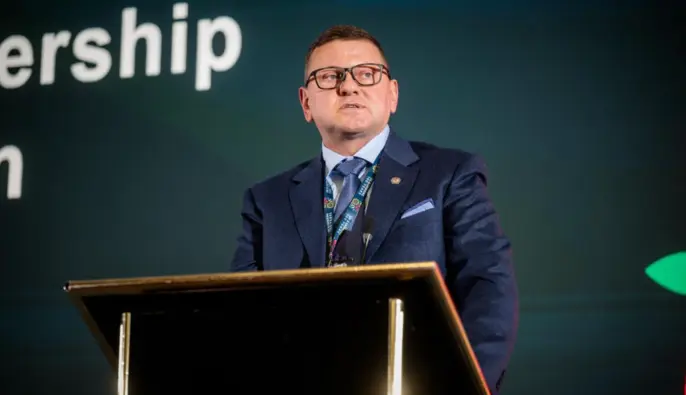
Speech by Valerii Zaluzhnyi, Ambassador Extraordinary and Plenipotentiary of Ukraine to the United Kingdom and Northern Ireland and Commander-in-Chief of the Armed Forces of Ukraine (2021–2024), at King’s College London on 25 March 2026.
