The arms market is a sphere where information kills in the most literal sense, and reputation is measured not by social media comments but by the number of shells delivered to the front line. The case of Polish logistics company PHU Lechmar — which travelled the road from the stigma of a "shady intermediary" to the official status of a trusted partner — has demonstrated the battles that play out in the market of modern defence procurement for Ukraine.
The most important thing to understand is that the arms market has its own distinct characteristics. This is not ordinary business, not a marketplace where one can freely choose and purchase any product. Different rules apply here — at the intersection of real war, domestic politics and large-scale intelligence operations. And where publicity is often the principal enemy.
This is especially true of sellers of Soviet-era munitions and their calibres. For the players in this market, excess information can cost them money, contracts, freedom — or even their lives: intelligence services conduct constant operational hunting of arms traders, supply routes and bank accounts. Excessive disclosure of a contract's details therefore means its immediate collapse, either through the Kremlin's diplomatic pressure on the producing country, or through the discrediting of suppliers before Western societies — propagating the narrative that Ukraine is a "corrupt black hole" where defence funds disappear. By destroying reputations, the enemy seeks to block logistics channels.
Alternatively, real acts of sabotage are carried out — such as the Russian attempts to poison the well-known Bulgarian arms dealer Emilian Gebrev with Novichok, and the sabotage operations at his weapons depots in Bulgaria and the Czech Republic.
It is also important to understand that in an era of global military-supply deficit, manufacturing plants and countries holding stocks of Soviet-calibre munitions avoid entering into direct contracts with a state at war. In doing so, they seek to preserve their neutrality or avoid political pressure. It is precisely for this reason that states turn to licensed private intermediaries capable of procuring ammunition through "third countries."
From Scandal to Recognition
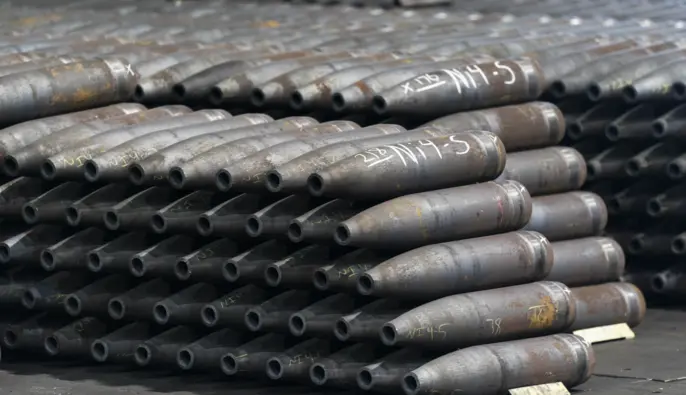
In late 2024, Ukraine's Ministry of Defence transferred 23 billion hryvnias to the State Border Guard Service (SBGS) for the emergency procurement of ammunition. The contract was awarded to PHU Lechmar, a Polish company largely unknown to the general public.
This triggered a wave of criticism within Ukraine. Anti-corruption activists and certain members of parliament publicly accused the agency of using "dubious intermediaries" and a "shell company"; allegations of delays and contract failures soon followed. The company instantly acquired a negative reputation in Ukrainian media.
Military officials subsequently explained the reasoning behind the decision: the front line was in urgent need of shells and rounds for Grad multiple rocket launchers, while the Ministry of Defence was unable to procure them. The former First Deputy Minister of Defence, Ivan Havryliuk, testified under oath (!) before a parliamentary temporary special commission investigating possible violations of defence and anti-corruption legislation during the period of martial law — in June 2026 — that at the time the Defence Procurement Agency (DPA) did not have the capacity to purchase the required ammunition. The contract was therefore transferred to the border guards, who sourced the ammunition and delivered it on time through the Polish company Lechmar. In other words, the decision was guided exclusively by the interests of the front.
The Russian Connection
The domestic criticism within Ukraine was exploited by Russian intelligence services to mount a powerful international discrediting operation. Russia's Foreign Intelligence Service generated a body of disinformation about "corruption" and "supply failures" at the SBGS. This information was picked up and disseminated within a matter of hours by more than 600 pro-Russian websites around the world. The disinformation spread in English (11.5%), French (3.9%), German (2.7%), as well as Spanish, Polish and Hungarian. The enemy took genuine statements by Ukrainian anti-corruption advocates or political disputes, stripped them of context and amplified them to Western audiences — seeking to undermine confidence in Ukraine as a reliable partner and to pressure Polish oversight bodies into blocking Lechmar's licences.
The Company's Explanation
PHU Lechmar attributes its competitive advantages to its willingness to accept stringent contract conditions — such as substantial penalties for delays. But procuring the goods is only part of the challenge: they must also be delivered to a country at war, where transit routes are under attack. Consequently, even the technical shifts in delivery schedules that critics interpreted as "contract failures" were in fact security-driven changes to logistics routes, made to protect the munitions from Russian missiles.
Strict contractual penalties, complex guarantee systems and logistics operating under fire create an environment that eliminates weaker players. Most market participants simply refuse to operate under such conditions.
The accusations against Lechmar as a "dubious intermediary" also look rather absurd given the company's many years of operating in full compliance with Polish law, under the strict oversight of supervisory bodies and in possession of all the necessary licences and security certifications — WSK, ISO, AQAP and an NCAGE organisation code.
Facts Against the Media Scandal
In June 2026, the situation changed fundamentally. First the company itself, and then SBGS spokesperson Andrii Demchenko, officially announced the full and successful completion of the 23-billion-hryvnia contract. All ammunition has been delivered to Ukraine; there are no outstanding claims against the Polish party. Moreover, the per-unit cost of the munitions from Lechmar proved to be among the lowest on the market, enabling significant savings of public funds.
Conclusions
The PHU Lechmar case demonstrates that in a hybrid war, the reputations of arms suppliers are just as much a target as military installations. The initial negativity surrounding the company was a mixture of a domestic information vacuum, speculation and a professional Russian disinformation campaign.
In the end, the ammunition supply contract was successfully fulfilled — notwithstanding the information attacks. And in the closed arms market, real results matter more than internet scandals. But for Ukrainian society and the media, this should serve as an instructive example: one must exercise greater caution when disclosing the details of defence procurement — so as not to inadvertently become an instrument in the enemy's hands.