


An escalating confrontation over Poland’s Constitutional Tribunal has exposed deep divisions between the country’s president and prime minister. Polish journalists and a Ukrainian political analyst tell Apostrophe why the dispute matters for NATO, European security and Ukraine.
Poland, one of NATO’s most important eastern-flank members and a crucial logistical hub for Western military assistance to Ukraine, is facing a renewed constitutional confrontation that threatens to deepen political divisions and complicate relations with its neighbors.
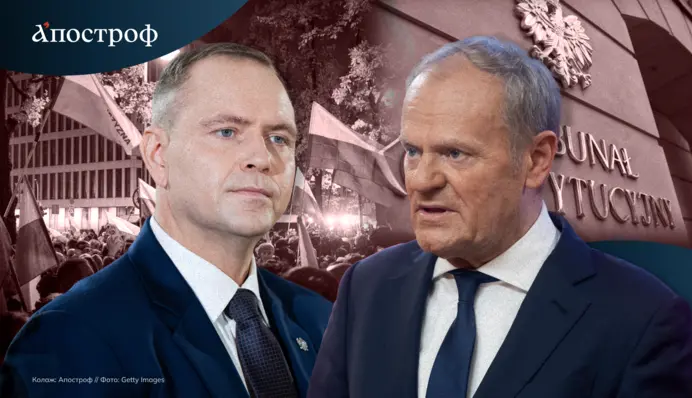
At the center of the dispute are Prime Minister Donald Tusk and President Karol Nawrocki, whose competing visions for Poland’s Constitutional Tribunal have left one of the country’s most important judicial institutions struggling to function.
The confrontation intensified in late October when demonstrators gathered outside the tribunal’s headquarters, accusing Nawrocki of pursuing policies that could undermine Poland’s position in the European Union. The demonstration subsequently descended into clashes with police.
But the crisis extends far beyond a dispute over judicial appointments. It reflects a decade-long struggle over the rule of law, the limits of presidential authority and the political legacy of the conservative Law and Justice party, known by its Polish acronym PiS.
For Ukraine and Poland’s Western allies, the stakes are particularly significant. Warsaw remains a central player in European security, and prolonged political instability could create opportunities for Russian disinformation and complicate cooperation with Kyiv.
Apostrophe spoke with Polish journalists Michał Potocki and Piotr Kaszuwara, as well as Ukrainian political analyst Yevhen Mahda, about the origins of the confrontation, the risks of political radicalization and what comes next.
A Constitutional Crisis More Than a Decade in the Making
Poland’s current judicial dispute dates back to 2015, when a controversy over appointments to the Constitutional Tribunal escalated into a broader confrontation between successive governments.
Tusk’s administration argues that PiS, which governed Poland for eight years before losing power, undermined judicial independence by installing politically loyal figures in key institutions.
Nawrocki and PiS reject the government’s efforts to restructure the tribunal, accusing Tusk’s coalition of disregarding established legal procedures.
The result is a prolonged institutional deadlock. The government has refused to publish certain tribunal rulings in Poland’s official journal, while the president has declined to recognize decisions associated with the reconstituted court.
Michał Potocki, a journalist with Poland’s Dziennik Gazeta Prawna, says neither political camp has shown much willingness to compromise.
“This constitutional crisis began 11 years ago,” Potocki told Apostrophe.
He recalled that the dispute began when Civic Platform appointed more judges than it was entitled to, before the incoming PiS government moved to reverse appointments beyond those initially contested.
“Today, the tribunal is a dead institution,” he said. “The government and the president have entrenched themselves in their positions and do not want compromises, because that would mean rewarding the enemy.”
Piotr Kaszuwara, a Polish journalist with TVP, places greater responsibility on PiS, arguing that its years in power transformed institutions traditionally considered independent into instruments of political influence.
“They placed their politicians in institutions that had previously been considered independent,” Kaszuwara said. “Everything was supposedly done according to the law, but these institutions became political tools.”
He acknowledged that some of the current government’s attempts to reverse those changes have themselves raised difficult questions about democratic procedures.
Kaszuwara compared the paralysis to Poland’s historical liberum veto, a parliamentary mechanism under which a single lawmaker could block collective decisions.
The analogy reflects a broader concern: Poland’s institutions may remain formally operational while their ability to resolve political disputes continues to deteriorate.
An Independence Day Ultimatum That Failed to Produce a Breakthrough
The confrontation became particularly tense ahead of November 11, Poland’s Independence Day.
Nawrocki had demanded that the dispute be resolved by the national holiday, warning that he could use all available instruments if no solution emerged.
The ultimatum raised concerns about a potential escalation between the presidency and the government, although the experts interviewed by Apostrophe did not regard a forceful removal of Tusk as a realistic scenario.
Potocki noted that the Polish president does not possess the constitutional authority to resolve the dispute through coercive measures.
Instead, Nawrocki could continue refusing to recognize the tribunal’s legitimacy, prolonging the institutional standoff.
Mahda believes the president’s confrontational approach also serves a political purpose.
During his presidential campaign, Nawrocki cultivated an image of physical strength and determination, including campaign imagery depicting him in a boxing stance.
“It was a nonverbal signal to voters: ‘I can punch someone in the face for Poland,’” Mahda said, describing the political symbolism of the campaign.
He suggested that Nawrocki’s recent actions were consistent with that image and could strengthen his support among voters seeking a more assertive political leader.
Yet the two sides also explored the possibility of a private compromise.
According to Potocki, Nawrocki and Tusk had tentatively agreed to meet without television cameras, advisers or public attention.
One concern was that the annual Independence March, which attracts large numbers of nationalist demonstrators, could become a flashpoint.
“There were genuine fears that the march could escalate into provocations,” Potocki said.
He explained that officials were concerned some participants might break away from the main procession and head toward the Constitutional Tribunal.
The planned meeting never took place. According to Potocki, additional conditions from both political camps and unrelated tragic events in Kraków contributed to its cancellation.
The November 11 deadline ultimately passed without a political breakthrough.
Tusk subsequently sought to revive the possibility of dialogue with an unusually personal invitation.
Speaking in Szczecin during Independence Day commemorations, the prime minister invited Nawrocki and his wife to his home before Christmas.
“My apartment is small, but there is room for both of us at the kitchen table,” Tusk said, proposing a conversation between the two leaders.
“Poland is worth our conversation. Poland is worth the solidarity of Polish women and men.”
At the time of the reporting, Nawrocki had not publicly accepted the invitation.
Nationalist Mobilization Adds Pressure
Poland’s annual Independence March has become another focal point of the political confrontation.
The event draws participants from across the nationalist right, although their political views and motivations are not uniform.
Kaszuwara argues that extremist elements within the march have increasingly shaped its public image.
He described the event as a “festival of hatred,” criticizing participants who use xenophobic and anti-Ukrainian slogans.
According to Kaszuwara, some Warsaw residents avoid areas surrounding the procession because of concerns about confrontations, while certain businesses close as a precaution.
His assessment reflects broader concerns about political radicalization, although it should not be taken as a characterization of every participant in the march.
Potocki said the possibility of unrest had become serious enough to influence discussions between the presidential administration and Tusk’s government.
The dispute also highlights a larger problem for Polish politics: political leaders may have incentives to mobilize their supporters through confrontation rather than seek compromises that could be portrayed as concessions to opponents.
Could Poland’s Government Collapse?
The judicial confrontation has also revived speculation about the future of Tusk’s coalition.
Former Prime Minister Mateusz Morawiecki has floated the idea of replacing the current government with a technocratic administration led by conservative politician Marek Jurek.
But the experts interviewed by Apostrophe expressed skepticism that such a proposal could command sufficient parliamentary support.
“There simply aren't enough votes in parliament,” Potocki said.
He argued that Tusk’s coalition partners would have little incentive to support such a move, particularly with another parliamentary election approaching.
Mahda identified the Polish People's Party, led by Władysław Kosiniak-Kamysz, as an important coalition actor whose decisions could influence the government's survival.
For now, however, the experts see little evidence that the opposition has assembled a viable parliamentary majority to replace Tusk.
That does not mean the confrontation will subside. Instead, it could continue through the next election cycle, with both sides using the tribunal dispute to mobilize their political bases.
Russia Sees an Opportunity in Poland’s Divisions
The consequences of Poland’s domestic crisis extend beyond its borders.
Poland is a NATO member, an EU country and a major transit route for Western assistance to Ukraine. Political instability in Warsaw therefore carries implications for regional security.
The experts interviewed by Apostrophe warned that Moscow could exploit the dispute by amplifying conflicting narratives and encouraging distrust between Polish political camps.
Potocki believes Russian information operations are particularly interested in deepening polarization rather than securing a victory for either side.
“Russian media don't care who wins. They're fans of chaos,” he said.
He pointed to contradictory narratives promoted by Russian political figures, including former President Dmitry Medvedev, as examples of efforts to fuel mutual suspicion.
According to Potocki, Russian messaging has alternately portrayed Nawrocki as resisting a political takeover and suggested that Tusk serves Moscow’s interests.
Such mutually inconsistent claims can be useful in information warfare because they reinforce existing suspicions among opposing audiences.
Kaszuwara also warned about the influence of pro-Russian narratives within segments of Poland’s far-right political environment.
He singled out figures such as Janusz Korwin-Mikke and criticized political currents that oppose European integration or promote positions favorable to Moscow.
These assessments concern specific political actors and narratives; they do not establish that Poland’s broader conservative opposition is acting on Russia’s behalf.
The underlying concern is that Moscow may seek to exploit domestic polarization at a time when Poland plays an essential role in European defense.
Why Ukraine Should Be Watching Closely
For Kyiv, the confrontation presents a political challenge.
Poland has been one of Ukraine’s most consequential European partners since Russia launched its full-scale invasion in February 2022.
Yet relations have periodically been strained by disputes over agriculture, historical memory and the treatment of Ukrainian refugees.
Kaszuwara expects Ukraine to become an increasingly prominent issue in Poland’s next parliamentary election campaign.
“Ukraine will absolutely be one of the campaign issues,” he said.
He anticipates renewed political disputes over the Volhynia massacres and allegations that Poland risks being drawn directly into the war.
Kaszuwara also raised the possibility of Russian provocations designed to intensify anti-Ukrainian sentiment, including hypothetical false-flag operations.
Those scenarios remain warnings rather than established plans or confirmed intelligence findings.
For Ukrainian policymakers, the challenge will be maintaining cooperation with Warsaw across political divisions rather than relying exclusively on one party or administration.
That may become increasingly important as Poland approaches its next parliamentary elections, scheduled for 2027.
A Crisis With No Easy Exit
None of the three experts interviewed by Apostrophe expects Poland’s constitutional dispute to be resolved quickly.
Potocki believes the confrontation could persist until at least the autumn 2027 parliamentary elections.
“We have already entered the election campaign stage, and during elections nobody is interested in compromises,” he said.
A lasting solution, he argued, would require a fundamental restructuring of the Constitutional Tribunal supported by a political agreement broad enough to restore confidence in the institution.
Such an agreement currently appears difficult to achieve.
The immediate risk is not necessarily a sudden collapse of Poland’s democratic system. It is the continued erosion of institutional legitimacy, with rival political camps refusing to recognize decisions made by institutions associated with their opponents.
For Washington, Brussels and Kyiv, that distinction matters.
Poland remains an indispensable member of NATO’s eastern flank. Its ability to sustain political cooperation, maintain public confidence in democratic institutions and resist foreign interference will have consequences well beyond Warsaw.
And as Russia continues its war against Ukraine, a prolonged confrontation inside one of Kyiv’s most important European partners is a development that neither Ukraine nor its Western allies can afford to ignore.