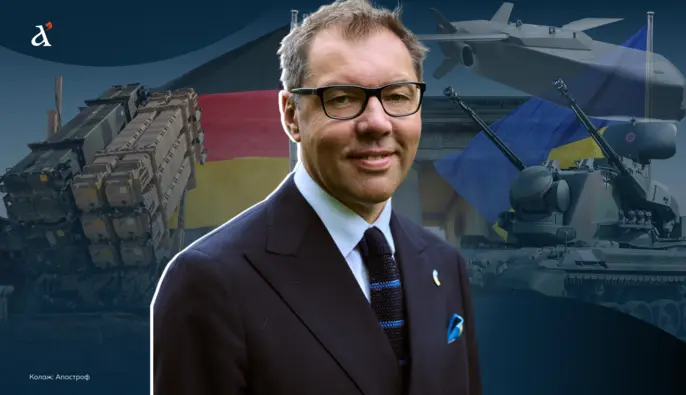

Oleksii Makeiev, Ukraine’s ambassador to Germany, said Berlin was preparing future Patriot missile supplies, deepening defense cooperation with Kyiv and slowly abandoning assumptions that shaped German security policy for decades.
Germany has become one of Ukraine’s most reliable European allies during Russia’s full-scale invasion, supplying five Patriot air-defense systems and €28.8 billion in military assistance since 2022.
But Oleksii Makeiev, Ukraine’s ambassador to Germany, says the more consequential change may be taking place beyond the numbers.
After decades in which many Germans believed that a major war in Europe had become nearly unthinkable, Russia’s invasion has forced Berlin to reconsider its military posture, its relationship with Moscow and the role Germany should play in European security.
“The Germans say themselves that for the last 30 years they genuinely lived with the conviction that peace had been established forever,” Mr. Makeiev said in an interview with Apostrof. “We would simply continue trading freely and living well, and weapons would never again be needed.”
“Russia confronted Europe with a different reality,” he added.
The shift has been slow at times, frustrating Ukrainian officials who have spent years pressing European governments for more weapons and fewer restrictions. But Mr. Makeiev said Germany was now moving toward a broader strategic partnership with Ukraine that included air defense, joint arms production, counter-drone technology and battlefield training.
Germany Is Preparing More Patriot Missiles for Ukraine
Germany has already provided Ukraine with five Patriot systems since 2023, more than any other country, according to Mr. Makeiev.
Now, Berlin has also financed a multibillion-euro contract that is expected to provide Ukraine with GEM-T interceptors for the systems.
“We have an agreement with the Germans,” Mr. Makeiev said. “Germany financed a major contract worth billions of euros. Under that contract, Patriot GEM-T missiles will be supplied to us.”
He declined to say when the deliveries would begin.
.png)
The secrecy reflects a broader problem facing Ukraine and its allies: Patriot interceptors are in short supply around the world.
“The whole world is looking for these missiles today,” he said. “Nobody has enough of them. No country will tell you how many it has left, and we will not say how many missiles we are going to receive. The enemy is listening.”
Germany, Mr. Makeiev said, has repeatedly searched both its own stocks and those of other countries for additional missiles for Ukraine.
He recalled that when President Volodymyr Zelenskyy first asked then-Chancellor Olaf Scholz for Patriot systems, Berlin initially provided one and indicated that it could do no more.
Germany ultimately delivered another four.
“I am confident that the discussions Minister Wadephul has been conducting about a certain number of missiles and permissions to send them to Ukraine will continue to produce results,” Mr. Makeiev said, referring to Germany’s foreign minister, Johann Wadephul.
Continue after commercial
‘Germans Are Waking Up’
Mr. Makeiev has spent much of his tenure trying to convince German officials, businesses and voters that Europe’s security environment has fundamentally changed.
At meetings with German business leaders, he has sometimes made the point with a deliberately provocative comparison.
A ceramics factory, he noted, can operate around the clock producing toilets because the furnaces cannot simply be switched off. Yet German industry has not always shown the same urgency about producing weapons.
“A kiln cannot simply be stopped, and everybody needs toilets,” he said. “But somehow there is still not the same understanding on the German side that weapons are equally necessary.”
The comment speaks to what Mr. Makeiev sees as a deeper psychological problem.
For three decades after the Cold War, Germany built much of its foreign and security policy around the expectation that trade and political engagement could preserve peace in Europe. Its armed forces shrank, military service became voluntary, and Russia remained an important economic partner.
Then came the invasion of Ukraine.
“Gradually — not as quickly as I would like — Germans are waking up,” Mr. Makeiev said.
Still, he said Ukrainian diplomacy had learned that simply berating Germans for moving too slowly was ineffective.
“You cannot talk to Germans by simply saying, ‘Hello, wake up,’” he said. “I try to choose words that resonate in their minds and in their hearts.”
Diplomacy, he added, required making Germans feel that Russia’s war was not a distant conflict.
.png)
“Our tactic as a diplomatic service is to build bridges at every level and create a common understanding,” he said. “Everything happening in Europe is happening, if not in your own backyard, then on the next street.”
The growing sense that Russian aggression could eventually threaten Germany itself, he said, has done more than almost anything else to change attitudes toward Moscow.
The AfD and Russia’s Narratives
That shift is far from universal.
The growing popularity of the far-right Alternative for Germany, or AfD, has raised concern in Kyiv about the endurance of pro-Russian sentiment inside German politics.
Mr. Makeiev said that, as an ambassador, he would not tell Germans how to vote. But he made little effort to conceal his alarm at the rise of parties he considers undemocratic.
“As a European and a democrat, it is very painful for me to see undemocratic parties gaining public attention and support,” he said.
He accused the AfD of repeatedly amplifying Russian narratives in speeches and at political rallies.
Mr. Makeiev pointed to a recent controversy in Saxony-Anhalt involving an AfD politician who was reported to have a mug bearing symbols of the Russian military.
The politician, he said, could not explain where it came from.
For Mr. Makeiev, the episode illustrated a larger problem.
“Undemocratic politicians are either under the influence of Russian intelligence services or fall into these networks voluntarily — or through their own stupidity,” he said.
But he also criticized Germany’s democratic parties, saying some had been reluctant to speak candidly with voters about the dangers and costs of the war.
German Troops in Ukraine? Not Yet
One question Germany has not resolved is whether its troops could eventually participate in a security or peacekeeping mission in Ukraine.
Under Mr. Scholz, Berlin publicly resisted the idea of sending German troops to Ukraine. Mr. Makeiev said the issue remained largely theoretical because Russia had shown no readiness for a settlement that could create the conditions for such a deployment.
“Today, we still do not see Russia demonstrating any readiness for negotiations,” he said.
Before governments could decide whether to send peacekeepers, he said, they would first have to determine their mission, size and mandate.
Ukraine’s military and negotiating team have developed ideas about what such a force could look like, Mr. Makeiev said. Germany, however, has not yet moved into detailed discussions.
There is also a domestic political obstacle: any deployment of German armed forces abroad would require parliamentary approval.
Germany has nevertheless confirmed that it will participate in exercises this fall, Mr. Makeiev said.
And the exchange of military knowledge is increasingly moving in both directions.
Under an agreement signed in February, Ukrainian troops will teach German soldiers lessons drawn from combat against Russia.
Taurus Is No Longer the Only Question
In Mr. Makeiev’s office at the Ukrainian Embassy in Berlin, a flip chart lists weapons that Germany has already provided to Ukraine.
The Taurus cruise missile is not among them.
A miniature model of the missile, however, sits on his desk.
For years, Taurus became shorthand for Germany’s reluctance to cross certain self-imposed thresholds in arming Ukraine. Friedrich Merz backed sending the missiles to Kyiv before becoming chancellor.
His government has since adopted a less public approach to future weapons deliveries.
Mr. Makeiev would not say whether Taurus remains under active consideration.
Instead, he argued that Ukraine’s rapid development of its own long-range weapons has changed the debate.
“Our Unmanned Systems Forces and our long-range ‘sanctions’ have completely changed the starting position,” he said, using a Ukrainian euphemism for long-range strikes inside Russia.
“The products now being manufactured by our defense industry have a much greater range than Taurus.”
Germany, he said, is increasingly interested in Ukrainian experience developing cruise missiles, medium-range systems and long-range drones.
Ukraine Is Teaching Germany How to Fight Drones
That experience has become especially relevant as Germany faces suspicious drone activity near airports and critical infrastructure.
After German authorities recently found a Russian drone at Leipzig/Halle Airport, Mr. Makeiev said he contacted the German Interior Ministry the following day and offered Ukrainian assistance.
Officials from the two countries are now in contact, he said, and are preparing agreements that include cooperation on counter-drone defenses.
During a recent trip to Ukraine, Foreign Minister Wadephul was shown Ukrainian electronic-warfare equipment at the Foreign Ministry in Kyiv.
.png)
The Drone Deal between Germany and Ukraine is primarily designed as a framework for industrial cooperation, Mr. Makeiev said. But the partnership could go further.
Ukrainian manufacturers and soldiers who have used the equipment in combat could help German authorities understand which systems work in practice.
“If Germans want to protect their critical infrastructure, it can hardly be done with systems that have never been used anywhere before,” he said.
Ukraine’s battlefield solutions, however, cannot simply be copied wholesale.
A powerful electronic-warfare system that is suitable for the front line, for example, could disrupt civilian communications if placed beside a German airport.
“The approach has to be comprehensive,” Mr. Makeiev said.
Germany’s ‘Red Lines’ Have Faded
For much of the war, military debates in Berlin revolved around what Germany would not provide Ukraine.
Mr. Makeiev said that phase was largely over.
Earlier in the invasion, German leaders imposed political restrictions based on concerns that certain weapons could escalate the war or be used across Russia’s internationally recognized border.
“All of that has changed,” Mr. Makeiev said. “Germany no longer restricts itself with red lines.”
That does not mean Berlin is prepared to hand Kyiv every weapon it requests, he cautioned.
Ukraine’s military needs are determined by its security and defense forces, he said, and each request is considered individually.
His role, he added, is to obtain as much of that equipment from Germany as possible.
The broader change, in his view, is that Germany no longer begins every discussion by asking what it must rule out.
Germany Has Spent More Than €60 Billion
The change is also visible in Germany’s spending.
Since 2022, the country has provided more than €60 billion in support for Ukraine and Ukrainians in Germany, according to Mr. Makeiev.
Of that, €28.8 billion has gone specifically toward military assistance.
Germany’s annual military support has increased sharply. Mr. Makeiev said it rose from €2 billion in the early stages of the war to €4 billion and then to €11.5 billion this year. Another €11.6 billion is planned for next year.
“Ukraine occupies an important place in Germany’s budget planning,” he said.
Germany has also spent €27.45 billion supporting Ukrainians who sought refuge there since the full-scale invasion, he said.
Those costs are beginning to change as more Ukrainians enter the labor force.
Employment among Ukrainians in Germany was about 15 percent during the first years of the war, Mr. Makeiev said. It has since risen to roughly 40 percent.
That means more Ukrainians are paying taxes and fewer depend entirely on government assistance.
The Debate Over Ukrainian Men in Germany
The status of Ukrainian men living in Germany has become an increasingly sensitive political issue.
Mr. Makeiev said recent discussions should not be interpreted as plans for forced deportations of Ukrainian men between 23 and 60.
Instead, he said, the debate concerns whether temporary protection should continue to be automatic.
Under the approach being discussed, men in that age group could be required to prove that they legally left Ukraine or provide documentation related to their military obligations.
“There is no question of forcibly transferring people to Ukraine,” Mr. Makeiev said.
Germany is now working to incorporate new European Union rules into national law and is consulting the Ukrainian government on implementation.
Among the difficult questions is how German authorities would verify whether someone left Ukraine legally.
Mr. Makeiev said there was no reliable figure for how many Ukrainian men between 23 and 60 currently live in Germany.
But the number itself, he argued, would say little.
“What matters is what percentage of these people have the legal right to travel abroad,” he said, noting that some men, including fathers of three minor children, are legally exempt from restrictions on leaving Ukraine.
Will 1.2 Million Ukrainians Come Home?
More than 1.2 million Ukrainians who fled the war are now in Germany, according to Mr. Makeiev.
Whether they will eventually return remains one of the most consequential demographic questions facing Ukraine.
Mr. Makeiev was reluctant to offer a sweeping prediction.
“The decision to leave or to return is entirely personal,” he said.
Some Ukrainians have already gone back and joined the armed forces, including people he knows personally.
.png)
He said he hoped many more would return after the war — perhaps bringing Germans with them.
Ukraine will need engineers and specialists for reconstruction, he said, while German defense engineers increasingly have reasons to work with Ukrainian colleagues whose weapons and technology have been tested in combat.
“Our arms manufacturers are counting on the German school of engineering and technology,” Mr. Makeiev said.
A Ukrainian Hub in the Heart of Berlin
For those who remain, Ukraine is expanding services inside Germany.
A Unity Hub opened in Berlin in April and has become a gathering point for Ukrainians living in the country.
The most popular service, Mr. Makeiev said, has turned out to be the Ukrainian Pension Fund.
He has even used it himself.
“I went there, too, and the Pension Fund employees explained everything to me,” he said, adding that they told him about the digitization of his own employment record.
The hub also includes an advisory center operated by the International Centre for Migration Policy Development, the United Nations refugee agency and Ukraine’s DP Document service.
Officials are also working to provide space there for Ukrainian nongovernmental organizations.
.png)
“This hub is becoming a center of Ukrainian life in the heart of Berlin,” Mr. Makeiev said.
Similar hubs could eventually open in North Rhine-Westphalia and Bavaria, he added, though he said the government could not realistically establish one in every German town.
In many places, Ukrainian communities have already done the work themselves.
“The Ukrainian community in Germany is fantastic,” Mr. Makeiev said. “They establish centers to support their fellow Ukrainians, they are active in the media and in politics, and they organize charity and cultural events.”
From Weapons to Energy
The expanding relationship is not limited to defense.
Ukraine began exporting biomethane to Europe in 2025, and the Ukrainian and German governments are now working on the legal framework needed to expand those supplies.
Some obstacles remain at the European Union level, including the rollout of the Union Database, a digital system intended to track the production, transport and use of renewable fuels.
Mr. Makeiev said both sides see substantial potential in the sector.
The effort reflects the broader transformation of relations between Kyiv and Berlin.
At the beginning of Russia’s full-scale invasion, much of the Ukrainian debate about Germany centered on hesitation: which weapons Berlin would refuse to send, which political limits it would impose, and how quickly it was prepared to recognize Russia as a long-term threat.
Four and a half years later, Mr. Makeiev argues that the relationship is increasingly about something else — joint production, shared military knowledge and a Germany preparing for a security environment very different from the one it expected to inhabit.
“Germany no longer restricts itself with red lines,” he said.