

"FIDE leaders Turlov and Podolyak don’t know how to play chess": Rosenstein alleges pressure during federation presidential election
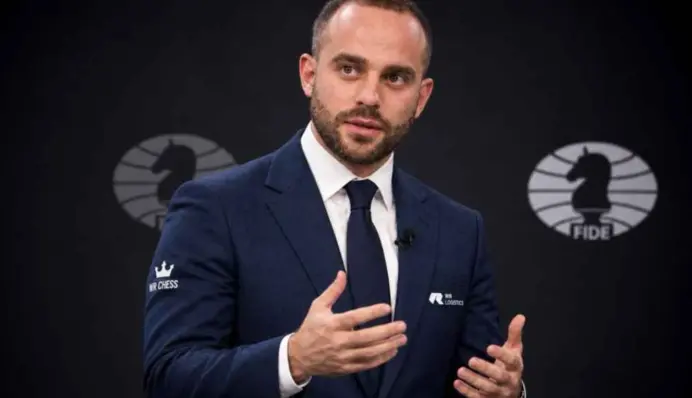
Wadim Rosenstein / Photo: WR Chess
-
 Ivan Troyanov
Editor, author of blogs, occasional writer. I understand a little about politics and economics. Previously, I worked in the "Arguments and Facts in Ukraine" (editor of the economics and politics sections). Also I was engaged in literary and volunteer activities.
German businessman Vadim Rosenstein, who ran for president of the International Chess Federation (FIDE), has denied allegations of ties to the Russian authorities and sanctions evasion. He has also revealed details of what he described as a dirty election campaign and a controversial presidential election in which Mykhailo Podolyak, an adviser to the head of Ukraine’s Presidential Office, became involved with the team of newly elected FIDE President Timur Turlov.
Rosenstein made the remarks in a comment to Apostrophe.
Allegations of ties to Russia and pressure during the election
According to the businessman, he faced threats and demands to withdraw his candidacy throughout the election campaign. He described it as one of the dirtiest campaigns in FIDE’s history and stressed that his sole objective had always been to promote chess.
“Throughout the entire election period, I was blackmailed and threatened with the imposition of Ukrainian sanctions, with demands that I withdraw my candidacy. I am not a politician. I am a businessman and a person wholly devoted to chess. There is only one thing that matters to me in this entire process — promoting chess!” Rosenstein said.
He also drew attention to what he described as a smear campaign against him in Ukrainian media, where allegations were published about his activities. According to Rosenstein, journalists did not contact him for comment before publishing their reports. Similar claims subsequently appeared in paid articles in English-language publications.
The businessman categorically denied allegations of sanctions evasion and the supply of military-related products. He maintains that the publications failed to identify any specific transactions, goods or entries on sanctions lists that could substantiate the claims.
“Not a single publication has named one specific transaction, product or entry on a sanctions list. […] This is a primitive manipulation and a distortion of the facts,” he stressed.
Rosenstein also rejected claims that he was allegedly acting as a Russian agent of influence. He said he had never received or carried out instructions from the Russian authorities and that his candidacy had been supported by the German Chess Federation.
The businessman also recalled that he had publicly called for the immediate implementation of Court of Arbitration for Sport rulings concerning the Chess Federation of Russia. At the same time, the Russian federation did not participate in the FIDE presidential election because its membership had been suspended.
Rosenstein also denied allegations concerning the Russian company VR Rus. According to him, he is not involved in managing the company and receives no dividends from it. The company is managed by an external administrator, while his exit from the business, he claims, requires approval from a Russian government commission.
He also said that WR Group had prohibited doing business with Russia and that the group's companies no longer enter into contracts with Russian counterparties. Previously signed agreements, he said, were fulfilled in accordance with EU law.
Commenting on reports about Italian footwear being imported into Russia, Rosenstein described the operation as an independent commercial activity conducted by a Russian company, unrelated to the German entities within WR Group.
He also denied reports of alleged supplies to the Russian company NOVATEK.
“All orders received by the group’s company came from European partners, and the company provided them with logistics services. I have already published evidence of this. Most importantly, all of this concerns events from 2019–2021, yet it is being presented as if it were happening right now. At the time, these supplies complied with the legislation in force, and they were discontinued in 2021. I do not personally know the owners of these companies,” he added.
Rosenstein stressed that his business operates in more than 70 markets worldwide, but, in his view, the publications focused exclusively on its Russian operations.
Challenging the FIDE election results
Commenting on the FIDE presidential election held in Samarkand on September 26, in which Timur Turlov defeated Rosenstein in the second round by 110 votes to 85, as well as the federation’s new leadership, Rosenstein said he did not recognize the results.
“I do not recognize the election results because I believe that Turlov and Payne violated Article 9.7 of the FIDE Electoral Rules, which explicitly prohibits candidates from engaging in actions, cooperation or collusion intended to deceive or manipulate the voting outcome. I have filed complaints with the Ethics Commission. Moreover, regardless of the outcome of my complaints, I am convinced that US and European sanctions against Turlov will be imposed soon,” he said. “That is why I am convinced that a new FIDE presidential election will take place in the near future.”
According to Rosenstein, he has submitted the relevant complaints to the Ethics Commission, and Turlov could face US and European sanctions. The businessman also expressed his conviction that the federation would soon hold another presidential election.
Controversy over Mykhailo Podolyak and Ukraine’s representation at FIDE
Rosenstein also commented on the controversy surrounding the involvement of Mykhailo Podolyak, an adviser to the head of Ukraine’s Presidential Office, in the team of newly elected FIDE President Timur Turlov.
In September, Podolyak accepted an invitation to join Turlov’s team, prompting objections from the Ukrainian Chess Federation (UCF). The Ukrainian federation stated that it had not authorized Podolyak to represent its interests at FIDE. In addition, the UCF challenged the federation’s decision to assign Podolyak an identification code under the Ukrainian flag, arguing that this had been done despite its objections.
On October 23, the European Chess Union (ECU) Board unanimously supported the UCF’s position at a meeting in Budva. The European and Ukrainian federations announced their intention to submit a joint protest against the decision of the FIDE General Assembly and seek its reversal.
“It is a disgrace that FIDE is now being run by Turlov and Podolyak, who have absolutely no idea how to play chess. I am ready to sit down at the board with either of them at any time and show who they really are,” Rosenstein said.
Against the backdrop of the dispute, Rosenstein criticized FIDE’s new leadership, claiming that Turlov had retained the influence of the team led by the federation’s former president, Arkady Dvorkovich. He pointed out that Viswanathan Anand had become a FIDE vice president, having previously held the same position under Dvorkovich.
“Today, after the election, we can clearly see that Turlov has fully retained Dvorkovich’s team and influence,” Rosenstein said.
Regarding the attacks and pressure he says he has faced, Rosenstein alleged that they were part of a campaign orchestrated by a prominent Ukrainian media figure who, he also claimed, had undertaken to secure the lifting of sanctions against Turlov in exchange for payment.
“I was born in Ukraine, in the Zhytomyr region, into a Jewish family, and I am a German citizen,” he said. “And for reasons I cannot understand, it is in Ukraine that I am being smeared, while some people, by contrast, praise Turlov, who was born in Moscow and continues to conduct extensive business there, despite the fact that Ukraine itself has imposed sanctions against him.”
What sparked the controversy
On September 26, the International Chess Federation held its presidential election in Samarkand. In the second round, Timur Turlov defeated Vadim Rosenstein by 110 votes to 85.
Before the vote, Rosenstein’s candidacy became the subject of public debate following media reports raising questions about his potential business ties to Russia and compliance with sanctions restrictions. The businessman denies the allegations.
Another part of the controversy concerns FIDE’s new leadership and Mykhailo Podolyak’s involvement in Turlov’s team. In September, Podolyak, an adviser to the head of Ukraine’s Presidential Office, accepted an invitation to join the new FIDE president’s team. The Ukrainian Chess Federation opposed the move, stating that it had not authorized Podolyak to represent its interests at FIDE.
On October 23, the European Chess Union Board unanimously backed the Ukrainian Chess Federation in the dispute over Podolyak’s status. According to the UCF, FIDE assigned him an identification code under the Ukrainian flag despite the federation’s objections.
The European Chess Union and the Ukrainian Chess Federation announced plans to submit a joint protest against the FIDE General Assembly’s decision and seek its reversal.