
Ireland has supported Ukraine since the beginning of Russia’s full-scale invasion and has provided assistance worth a total of €670 million. This includes, among other things, radar systems, armoured vehicles and funding for the energy sector. Dublin also supports Ukraine’s European integration.
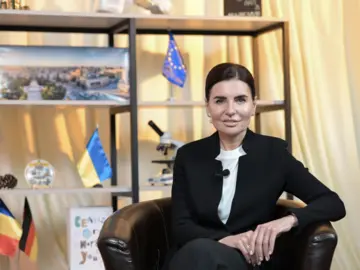
Ukraine’s Ambassador Extraordinary and Plenipotentiary to Ireland, Larysa Gerasko, told Apostrophe in an interview that during Ireland’s presidency of the EU, the country would work to facilitate the opening of the remaining negotiation clusters for Ukraine.
In addition, the Irish parliament is discussing changes to the mechanism governing the deployment of Irish troops abroad. Among other things, this could affect Ireland’s ability to participate in a potential peacekeeping mission in Ukraine.
– The Irish authorities have placed the alumina plant owned by Russian oligarch Oleg Deripaska under scrutiny, but an investigation into the company’s operations did not answer the question of whether alumina is being supplied to Russia. How long will this monitoring continue? Will the destinations of the plant’s exports be examined as part of it?
– There is no doubt that Aughinish, a company located in County Limerick that produces alumina and exports it to Russia, is owned by Rusal, which is linked to Deripaska [Russian oligarch, owner of the Basic Element holding company, billionaire and one of Russia’s wealthiest people, Oleg Deripaska – Ed.].
After the start of the full-scale invasion, the Russian oligarch reduced his ownership stake in the plant. In this way, the company was effectively removed from the scope of sanctions. Today, exports from the plant to Russia have increased significantly.
– How much?
– Before the full-scale invasion, Russia ranked second in terms of export volumes. Now the aggressor country has moved into first place. Exports have increased by 50%.
The Irish government’s investigation concluded that there was no connection between their alumina and weapons production. However, the company continues to supply alumina in the direction of Russia. I will bring back some additional facts from Kyiv that demonstrate a link between alumina from this enterprise and weapons production. But finding direct confirmation is extremely difficult.
The enemy imports alumina from many countries, including China. As a result, raw materials from different sources are mixed together. It is therefore very difficult to isolate the Irish share in that mixture.
We continue to work with the Irish side. The report has now been forwarded to Brussels. Our specialists are also involved in studying the materials.
.png)
– And what happens after the Europeans finish studying the findings of the investigation? What steps could they take next?
– They could consider imposing sanctions. Perhaps someone in Europe might want to acquire these production facilities. There are many possible ways to address this issue.
– Ireland recently provided Ukraine with another tranche of non-lethal military assistance worth €125 million. At the same time, Dublin maintains a policy of neutrality and does not supply us with lethal weapons. Is there any mechanism that could circumvent this neutrality — for example, separate agreements with Irish arms manufacturers?
– Yes, Ireland is militarily neutral, but it provides us with financial and political support. You mentioned the latest assistance package: €100 million for the purchase of non-lethal military equipment and €25 million for the energy fund.
Ireland has also provided us with radar systems, armoured vehicles and other equipment. Ireland itself has an army of only about 10,000 personnel. It does not have this kind of weaponry and does not manufacture it.
– You have also spoken about Ireland’s participation in the Coalition of the Willing. What is its role in this format, given its neutral status?
– Ireland participates like everyone else. It focuses on political support and financing for Ukraine. We have Ireland’s full support for our European integration course.
It was during the Irish presidency that the sixth negotiation cluster was opened. We hope that the remaining four will be opened by the end of this year.
– Ms Gerasko, you say that Ireland will work to open the remaining clusters in Ukraine’s EU accession negotiations during its presidency of the Council of the EU. But there is still the Hungarian factor, as Budapest repeatedly blocks the opening of these clusters. Do the Irish have a plan for how to deal with Hungary?
– Bilateral diplomacy will help us here. Ireland is talking to the Hungarian authorities. We are working on all of this. We have earned the right to be in the EU. We are fulfilling all our obligations, as confirmed by the European Commission’s report. At the same time, there is still a great deal of work for us to do.
.png)
Last Bell celebration at the Ukrainian Saturday School “Ridna Shkola” in Dublin / Photo: facebook.com/ukr.embassy.ireland
– In a previous interview, you spoke about the so-called Triple Lock mechanism. Because of its neutral status, Ireland cannot deploy more than 12 soldiers on missions abroad without UN approval.
You said that the government is now trying to persuade Parliament to turn the Triple Lock into a Double Lock — in other words, to remove the requirement for mandatory UN approval before Irish troops can be deployed abroad. How is that process progressing?
– Such decisions are difficult for a neutral country, particularly when the opposition is strongly against them. At the same time, the coalition government argues that it cannot be held hostage by Russia, because Russia can veto any decision in the UN Security Council. That is what this debate is about. Discussions are ongoing. The government is explaining to the public why moving away from this aspect of neutrality is important.
I believe the process will ultimately succeed. I think the relevant decision will be adopted after the end of Ireland’s EU presidency. The Irish government has repeatedly stated that, once a ceasefire is in place, it would be prepared to participate in monitoring, for example. But all of this will only become possible once the Triple Lock is changed.
– So, after the Triple Lock mechanism is relaxed, could Ukraine theoretically expect around 50 Irish peacekeepers, as you mentioned previously?
– You can see that Putin does not want peace. So the participation of Irish peacekeepers remains a distant prospect for us.
– Let us talk about Ukrainians in Ireland. There are currently said to be between 80,000 and 84,000 Ukrainians there. What share of them are temporarily displaced because of the war, and what conditions are they living in?
– The figure you mention refers only to citizens under temporary protection, but it is not entirely accurate. What we can say with certainty is that the number is approaching 90,000 as of today. These are Irish figures.
In addition, around 16,000 Ukrainians lived here before the full-scale invasion. If we add people on work visas, the total comes to around 100,000–110,000.
Overall, Ukrainians make up about 2% of Ireland’s population. We have up to 40 Ukrainian organisations, 12 Ukrainian weekend schools, as well as churches.
.png)
– In last year’s interview, you said that the Irish government spent €2 billion on the needs of Ukrainians in 2024. What does that figure look like today?
– Ireland had been spending around €2 billion a year. Altogether, since 2022, €5.5 billion has been spent on Ukrainian refugees from the war. This includes accommodation, payments to host families, language courses, social assistance and medical care. At one stage, Ukrainians also had access to free public transport.
– You mentioned old houses that Ukrainians could theoretically renovate and move into, but you stressed that many of those properties were in very poor condition…
– Nothing has changed since then. From 1 September, our citizens will face a reduction in the amount of accommodation provided by the Irish state. Today, 16,000 Ukrainians are living in such accommodation. State-provided accommodation includes hotels, social centres and other facilities.
From 1 September, all Ukrainians living in this type of accommodation will have to leave and find housing on their own, with the exception of vulnerable groups. These include, for example, single mothers with young children and elderly people with special needs. An individual application will have to be submitted for consideration. We managed to secure this exception.
Everyone else will have to find accommodation themselves. I believe that after five years, it should have been possible to resolve this issue. Unfortunately, many people are still not working. Only about 60% are employed. The other 40% have chosen not to work.
Payments to host families accommodating Ukrainians will also be reduced somewhat later. It will be difficult for people because Ireland has been experiencing a housing crisis for decades. There are very few properties available to rent, and they are also extremely expensive.
So around 6,000 Ukrainians who fall into vulnerable categories will be able to continue staying with host families. As for the remaining 10,000, I do not know how they will manage to find accommodation after 1 September.
.png)
– Across Europe, there have recently been more calls to send Ukrainian men who are fit for military service back home. What is Ireland’s position on this?
– That will not happen in Ireland. There are no official discussions about it here. Irish citizens themselves are not conscripted into their own army. At the same time, the authorities in Dublin are very concerned about the number of men entering Ireland. That is true. They ask us about it.
Even ordinary Irish people who meet me at public events ask what our men are doing here. It is an issue that concerns people.
– And how do you respond to questions like that?
– I say that I do not know on what grounds any particular man is staying here. When it comes to young people who have the legal right to leave Ukraine, I explain that they are not yet of mobilisation age. You cannot keep them locked up.
– But if the Irish are concerned about the presence of Ukrainian men, why do they not simply ban them from entering the country?
– As I said, no such discussions are taking place officially. Knowing the Irish commitment to equality, I believe the likelihood of such a ban is very low.
– Finally, let us talk about Ukraine’s reconstruction. You previously mentioned two Irish companies involved in rebuilding efforts: Kingspan Group and Cement Roadstone Holdings. What other corporations are planning to participate in reconstruction, and which regions will they focus on?
– CRH has been present here since 1999. Kingspan arrived after the start of the full-scale invasion. On 2 December 2025, the first Ukrainian-Irish Economic Forum was held. We are working to encourage investment. We are inviting agricultural, pharmaceutical and construction companies.
On 2 December this year, the forum will be held again — this time in Dublin rather than Kyiv. We plan to establish a bilateral economic council. It will not be limited to an intergovernmental format; representatives of Ukrainian businesses will also attend.
We are actively working with Ukraine’s Ministry of Economy and Ireland’s Department of Foreign Affairs and Trade on the programme for the upcoming event. We hope to sign memoranda that will help us attract more investors. But we do not want to get ahead of ourselves.
.png)
– How do Russian diplomats behave in Ireland? How active are they?
– I do not meet them and have no intention of doing so. We do not cross paths. I encountered the Russian so-called ambassador only once, at a reception hosted by another country. I do not consider it necessary to stay at a reception where he is present. I might only come in briefly to greet other colleagues out of courtesy.
As for their activities, yes, they have become more active. Since last September, we have noticed an intensification of their efforts. They spread their narratives in different ways.
It is difficult to counter this, but we are trying, together with Irish officials. Every year, Russians organise their so-called “Immortal Regiment” events here. It is impossible to ban them. The Irish place a very high value on freedom of speech, and this is enshrined in their legislation.
The Russian ambassador constantly tries to manipulate the issue of Irish government assistance to Ukraine, portraying it as Ireland abandoning its neutrality.